Faces of Faculty: Pearl DeSure
By Marcia Wilson
This interview is part of a series meant to introduce our college community members to a broader readership. Inspired by “Wild Card with Rachel Martin,” our intrepid interviewer has a variety of questions that are numbered and fall into different categories. The subject picks a number and the interview begins with neither party knowing what question will come next.
Like many of the faculty at Clover Park Technical College, Pearl DeSure wears many hats. A Faculty Librarian, she can be found in the Learning Center, Building 15 on most days, solving problems in her office or interacting with students and staff.
Marcia: Thanks for taking the time to talk to us, Pearl! How would you describe your role here, to someone who doesn’t know about you and the LRC?
Pearl: As the faculty librarian, I am responsible for developing policies around how students use the library, as well as selecting and maintaining access to books and electronic resources that are most relevant to student work (excluding textbooks). I work with my co-workers to develop processes that make the library space comfortable and safe for students. I’m also available to work with students one-on-one on research assignments, essays, or any other questions they bring to the LRC.
Marcia: (Category: Mindset & Values) What’s one thing you’ve learned from students since working here?
Pearl: I’ve learned that it’s never too late to try something new. I’ve been really impressed by how many of our students return to school after years away and often pursue entirely new career paths. It’s genuinely inspiring.
Marcia: (Category: Role & Impact) What’s a project or initiative you’re especially proud of contributing to?
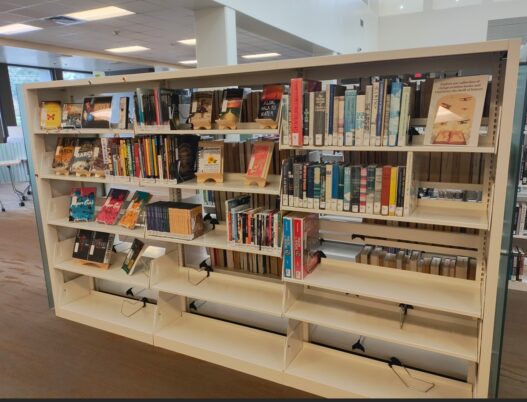
Pearl: Our library received a small grant from the Washington State Library to purchase books for English language learners (ELL). At the time, we had a small and somewhat disorganized ELL collection, and the grant really jumpstarted our efforts to expand and improve it. We replaced outdated graded readers with newer editions and, at the ELL Faculty Lead’s suggestion, added picture dictionaries in multiple languages. Those dictionaries have become especially popular with students. We could do a better job of making the collection more visible, but I’m proud of how much it has grown—and it’s incredibly rewarding to show the collection to students and see how excited they are that these materials are available to them.
Marcia: (Category: Personality & Connection) When you think about your future, what are you excited to learn or do next?
Pearl: I’m both excited and a bit cautious about the growing role of AI and what it could mean for the future of libraries. There’s a lot of potential for using AI to streamline workflows, make better sense of data, and create more time for work that directly supports students. I’m really interested in learning how to use these tools responsibly and in helping students understand how AI works, what it’s good at, and where its limits are, so they can use it thoughtfully as part of their learning.
NOTE: Curious about ELL? The state of Washington has an English Language Learners population of 107,307 students in the public school system. With a total enrollment of 1,051,694, ELLs make up just over 10% of the students enrolled in grades K-12. The five languages spoken by ELLs are Spanish, followed by Russian, Vietnamese, Somali, and Chinese.–Taken from the Latino Family Literacy Project
In 2024 the State of Washington voted unanimously to fund at least 10 new language programs each year. The end goal is for all invested school districts to offer these programs to all engaged schools by 2024. (RCW 28A.300.577)
Marcia: (Category: Optional & Extras) What led you to pursue a career at a technical college?
Pearl: That was a bit of a happy accident. I’ve worked in a few different types of college libraries during my career—from small community colleges to large research libraries—but I’d been out of the field for a few years. I wanted to get back into the profession, particularly at a small college library, so when a job became available at CPTC, I went for it.
Marcia: Also, curious about your LinkedIn—Copyright First Responders? This sounds interesting!
Pearl: Copyright First Responders is a national network of librarians, archivists, and museum staff who have been trained to provide copyright guidance and can act as a resource for their institution and patrons for everyday copyright questions. I’m part of the Pacific Northwest Chapter, and even though I’m not super active in the group, the training I received has really helped me develop clear guidelines for both students and faculty at the LRC, and it makes me feel more confident answering questions when they come up. The chapter listserv is also a great resource when I need to ask more complex or nuanced copyright questions.
Note: Pearl is referring to the CFRPNW, which covers the states of Washington, Oregon, and Idaho. The Chapter began in 2018 with grant funding from the Library Consortium, Orbis Cascade Alliance,
Marcia: Pearl, thanks for taking the time to talk, and thanks for giving us a change to talk about ELL!
Wild Card at CPTC is a blog series sharing the real stories of our students, staff, and faculty—because education is about people, not just programs.